
The C&D Canal
Construction…
In 1822, the C&D Canal Company reorganized, discovering that over $2 million would be needed to continue construction. Pennsylvania invested $100,000, Maryland $50,000, Delaware $25,000, and the federal government $450,000, with the remainder raised from the public.
The U.S. Army Corps of Engineers played a crucial, though unofficial, role in planning the route. Along with two civilian engineers, they recommended a four-lock course from Newbold’s Landing Harbor (now Delaware City) west to the Back Creek branch of Maryland’s Elk River.
Construction resumed in April 1824, employing roughly 2,600 laborers wielding pick and shovel through swampy, slide-prone terrain, earning just 75 cents a day. After five years of grueling work, the canal officially opened in 1829 at a cost of $3.5 million, making it one of the era’s most expensive canal projects.
In 1825, chief engineer John Randel Jr., who had completed the difficult eastern section, was dismissed. He sued for breach of contract, winning $226,885.84 in 1834—over $7 million today. Appeals reached the Supreme Court, which upheld the award, and state legislatures required the canal company to pay its debts within five years. The judgment nearly bankrupted the enterprise.
Despite setbacks, the C&D Canal endured, a testament to early American engineering and the determination of the workers who built it.
1829 to 1919…
The Chesapeake & Delaware Canal stretched nearly 14 miles, 10 feet deep, 66 feet wide at the waterline, with 36-foot-wide channels at the bottom. A covered wooden bridge at Summit, Delaware, spanned 250 feet across the “Deep Cut,” with the floor 90 feet above the canal. Three wooden swing bridges and locks at Delaware City, St. Georges, and Chesapeake City facilitated vessel passage. The locks, originally 100 by 22 feet, were later enlarged to 220 by 24 feet.
Freight and passenger vessels—including barges, schooners, and sloops—were towed by teams of mules and horses. Cargo ranged from lumber and grain to coal, iron, and whiskey. Packet services, most notably the Ericsson Line, carried freight and passengers between Baltimore and Philadelphia into the 1940s. The line’s steamers grew from under 100 tons to over 600, with 70–80 staterooms added for passengers. Named for its first ship, Ericsson, built in 1843 with a screw propeller by John Ericsson, the line operated from Baltimore for 75 years, greatly boosting canal trade and regional prosperity.
Lock water loss was an early problem. Steam-powered pumps and a large waterwheel, installed in Chesapeake City between 1837 and 1854, lifted water into the canal’s upper levels. The engines lifted 170 tons per minute, consuming eight tons of coal daily, and remained in use into the 1920s.
Throughout the 19th century, the canal faced competition from the New Castle and Frenchtown Turnpike and Rail Road. Steam vessels required larger locks, and by the early 20th century, declining traffic and high operating costs highlighted the need for a larger, deeper canal. Multiple new canal routes were proposed, but agreement was elusive until 1906, when President Theodore Roosevelt appointed a commission to study the feasibility of converting the canal into a free and open waterway.
Photos: (Above) Eastern Lock of the Chesapeake & Delaware Canal, Battery Park, December 2011.
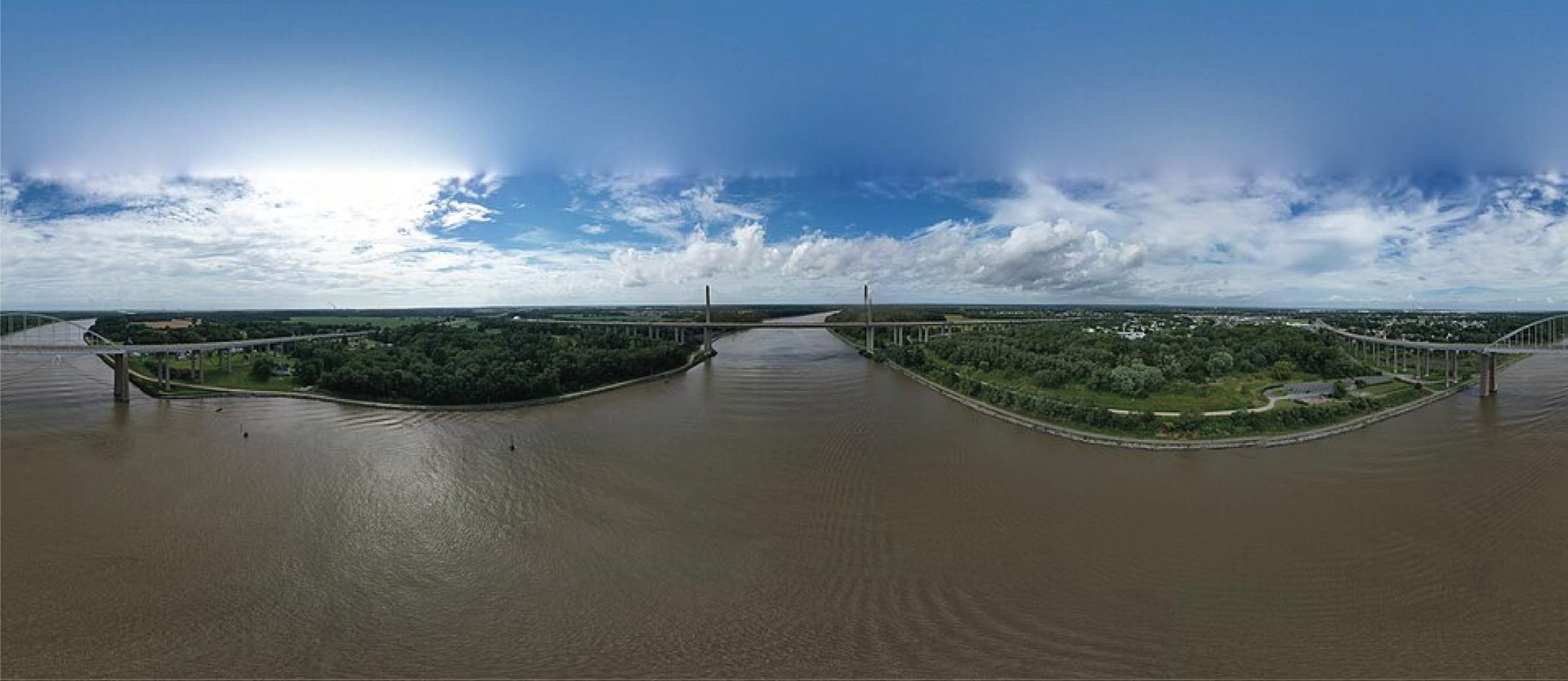
(Bmid-article) A 360 photosphere shot from above and between the St. Georges and the William V. Roth Jr. Bridges.
Read more articles from VOM Magazine here: www.veteransoutreachministries.org/vom-magazine