1920s to 1970s: Expansion and Modernization…
By 1919, the federal government purchased the canal for $2.5 million and formally designated it part of the Intracoastal Waterway linking the Delaware River to the Chesapeake Bay. Over the next several decades, the Chesapeake & Delaware Canal would undergo major transformation to accommodate the rapid growth of commercial shipping.
Responsibility for operating and improving the canal was assigned to the U.S. Army Corps of Engineers. In the mid-1920s, work began to relocate the eastern entrance several miles south to Reedy Point, Delaware. Most of the original locks were removed, and the canal was converted to a sea-level waterway. By 1927, the “new” canal opened to great celebration, reflecting a modernized vision for American commerce.
As ships grew larger and heavier, the channel required further deepening and widening. Between 1935 and 1938, improvements expanded the canal to 27 feet deep and 250 feet wide. A federal navigation channel was also extended into the Upper Chesapeake Bay, improving access for larger vessels traveling between major ports.
Despite modernization, challenges remained. Increasing ship traffic led to accidents and congestion, particularly at bridge crossings. Between 1938 and 1950, multiple bridge collisions highlighted the need for safer, higher spans. Congress authorized additional expansion in 1954, ultimately widening the channel to 450 feet and deepening it to 35 feet. These improvements, completed in the mid-1970s, allowed the canal to safely accommodate modern commercial vessels.
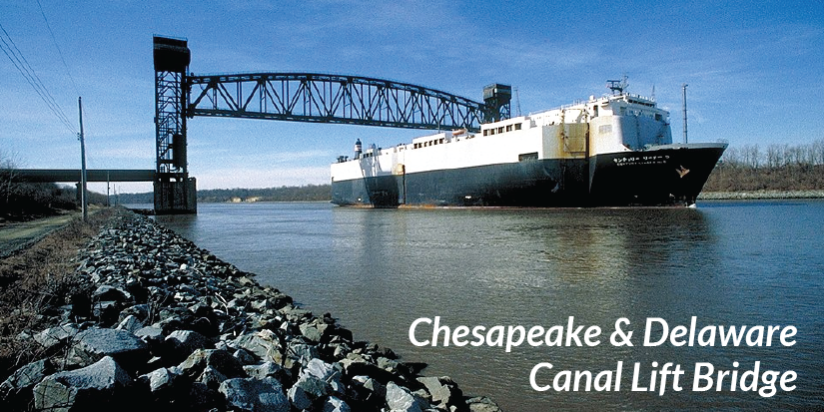
New high-level bridges replaced earlier lift spans at key crossings, including Summit and Reedy Point. In 1966, a new railroad lift bridge was completed to support freight movement across the canal.
By the late 1960s, advancing technology began replacing traditional canal patrol boats with centralized monitoring systems. Radar, radio communication, and closed-circuit television modernized canal operations. In November 1968, patrol boat operations were officially retired, marking the end of an era and the beginning of a more technologically advanced system.
Through decades of expansion and innovation, the C&D Canal evolved from a modest 19th-century waterway into one of the nation’s most strategically important commercial shipping routes.
Post-1970s: A Modern Maritime Gateway…
Today, the Chesapeake & Delaware Canal stands as a fully modernized, sea-level commercial waterway and a vital northern maritime gateway to the Port of Baltimore. Electronically monitored and professionally managed, it remains one of the most strategically important shipping corridors in the Mid-Atlantic region.
Since 1933, the U.S. Army Corps of Engineers’ Philadelphia District has overseen canal and bridge operations from Chesapeake City, Maryland. Commercial cargo ships, tankers, container vessels—including Seawaymax-class ships—along with tug-guided barges and recreational boats create a steady flow of traffic. Advanced fiber-optic systems, radar, radio communications, and closed-circuit monitoring allow dispatchers to safely and efficiently guide vessels through the waterway.
Navigating the canal requires significant maritime skill. Strong currents, narrow margins, and changing weather conditions demand experienced leadership. For vessels engaged in foreign trade, a United States Coast Guard-certified pilot is required during transit. Typically, a Delaware River and Bay pilot boards near Lewes, Delaware, guiding the ship into the canal at Chesapeake City, where a Maryland pilot assumes control for the journey south toward Baltimore or Annapolis. For eastbound vessels, the process is reversed, with pilot transfers taking place while ships remain underway.
From mule-drawn barges to radar-guided commercial giants, the C&D Canal has continually evolved to meet the demands of commerce. More than two centuries after its conception, it remains a powerful example of American engineering, adaptability, and maritime strength.
Read more articles from VOM Magazine here: www.veteransoutreachministries.org/vom-magazine